I Ramble For Way Too Long About Magical Tetris Challenge (GBC, 1998) And Also Give A Comprehensive Guide To The Game
Preface
I have played this game far, far more any reasonable person should have. I felt like it was a waste to keep all this knowledge to myself, so I am now leaving you with the burden of knowledge for a 28-year-old game.^This sentence doesn't make me feel right. I need to get better at comprehending the passage of time. I wish you the best.
Before I begin discussing this game, I need to let out a couple disclaimers:
- This article is about the Game Boy Color version of the game, not the arguably more popular N64/PS1/arcade versions*I collectively refer to these as the "console versions". The N64 and PS1 versions are completely identical, and the arcade version is exactly the same but with only Story and Vs mode.. Most prominently, the story mode in this game is much more than just a handful of consecutive CPU battles, and there's like three new variants in this game. You should play it if you haven't -- it's really good!
- I have done all of my game testing on the European 1.1 and American 1.0 versions of this game. I am unaware of any regional differences, and certainly none that would affect the gameplay. That doesn't mean that there aren't regional differences, though, so I can't guarantee anything.
- This article mostly pertains to Quest Mode, but the general Tetris advice works well in the singleplayer modes, too. There are other sources that go in-depth on Magical Tetris (the primary mode in the N64/PS1/arcade versions), such as this page on TASVideos, so you should check those out if you're interested in some extra details.
- Values that depend on difficulty will be denoted as X/Y/Z, denoting Easy, Normal, and Expert respectively.
- Asterisks (*) denote actual footnotes, and carets (^) denote fun commentary. Hover over them to view.
With that out of the way, buckle up! It's going to be a long ride!
Game Overview
Magical Tetris Challenge for the Game Boy Color is a top-down RPG that also happens to be a Tetris minigame collection. I say this with a reasonable amount of sarcasm, but this definition is not strictly incorrect.
The primary mode of the game is Quest mode, which has you play as one of four (or five, if you've unlocked them) Mickey Mouse characters, running around in the Tetris Coin Rally to be the first of five participants to collect six specific numeric coins. In order to do so, you have to participate in various variants of Tetris, some of which are against a the other participants or another simulated CPU-controlled opponent.
In addition to Quest Mode, there is a singleplayer mode where you can play any of the Tetris variants freely (though you have to unlock half of them by playing Quest Mode), a 2P versus mode using the Game Boy Link Cable, and an option to view your high scores. I will be covering each of these modes in order, starting with all the different variants you will encounter, so that I can discuss all the Tetris stuff in this game first. For Quest Mode specific topics, scroll down to that section.
Variants
MTC includes a surprising amount of Tetris variants, totalling to six variants, plus a secret seventh variant exclusive to 2P mode. I will be covering all of them in order.
Standard Tetris
Assuming you've played Tetris before, this mode should look quite familiar. You're given a sequence of falling pieces, and your goal is to move and rotate them to fill complete lines in the playfield for points. If you're a Tetris connoisseur, however, you should note that this version plays quite differently to a lot of the other contemporary versions (including Tetris DX for the same console):
- The playfield is 18 rows high, compared to the standard 20 in most console ports of the game. Both the original Tetris (GB) and Tetris DX (GBC) also have 18-row-high playfields, likely due to the smaller screen size of the Game Boy (Color).
- The pieces have a custom colour scheme and rotation system. The colour scheme is actually different than the N64/PS1/arcade versions, and is as follows:
red I,
blue J,
pink L,
cyan T,
green S,
orange Z,
yellow O.
The rotation system appears to be identical to the console ports of the game, and
unfortunately there is no universal source of truth for how it works.UPDATE: I have figured out the exact mechanics by peeking into the source code of the GBC port. The Tetris Wiki page has my notes on the rotation system. - The pieces spawn vertically, just like the console versions. This is enough to mess up your muscle memory, so be prepared.
- The randomizer is strange. It picks pieces using a weighted distribution: I has weight 48, J and L have weight 40, and T, S, Z, and O all have weight 32.
Other than that, though, the mechanics are familiar. Gravity slowly speeds up over time in this mode (along with all the other modes, see below), and the lock delay is 30 frames of total lock delay. That is, your piece can only be on the ground for 30 frames before it locks, regardless of if it drops further in the meantime. This will be important when we cover Target Tetris.
In Quest mode, this mode is renamed to Challenge Tetris, and you are given either a score goal, a line goal, or both to meet in a specified time limit. The goals and time limits vary based on who gives you the challenge; see the Quest Mode section for details. In singleplayer, this is just an endless mode with nothing special going on.
Scoring
| Easy | Normal | Expert | |
|---|---|---|---|
| Single | 20 | 100 | 300 |
| Double | 50 | 250 | 1000 |
| Triple | 150 | 750 | 3500 |
| Tetris | 600 | 3000 | 8000 |
| Pentris | 1000 | 5000 | 12000 |
I will also take this time to make a note of the scoring mechanics. The base amount of points you earn for a line clear depends on your difficulty, shown in the table on the right. Additionally, if you clear a combo (multiple line clears with consecutive pieces), you gain more points:
In Easy, each clear in a combo is worth 1x more than the previous. The first line clear in a combo is worth 1x, the next is worth 2x, then 3x, 4x, 5x, and so on.
In Normal and Expert, the amount of points you get for a line clear is multiplied based on the Fibonacci sequence*This is different from the console versions! In those versions, each multiplier is twice as much as the previous: 1x, 2x, 4x, 8x...: the first clear is worth 1x points, the next is worth 2x, then 3x, 5x, 8x, and so on. For example, clearing a single immediately followed by two Tetrises on Normal awards 100, 6000, and 9000 points respectively for each line clear. This is very powerful, and makes it possible to get extremely high scores (especially in Towering Tetris, see below).
Every mode uses this scoring method, with the exception of Signal Tetris, which uses its own scoring (see its own section).
Gravity
Gravity in this game is weird. The following description is sourced from a partial disassembly of the game, and I have no clue why they implemented it this way. For this section, I refer to "gravity" in units of frames per cell, not the usual "drop rate".
Whenever the game begins, your speed level starts at 0, and your speed offset starts at 5. Every 18/10/7 pieces placed, your speed level increases. Whenever your speed level reaches 10, if your speed offset is greater than 0, you go down two speed levels and your speed offset decreases by 1. If your speed offset is already 0, you go back down to speed level 9 forever.
If your active piece is the Shot Block (from Towering Tetris, discussed later), gravity is forced to 60 frames/cell. If you play Signal Tetris on Expert, the gravity acts as if you were in Normal difficulty. Otherwise, the gravity is equal to the value shown in this chart, indexed by your speed level minus your speed offset, capped to a minimum of 0:
| Lv-Off | 0 | 1 | 2 | 3 | 4 | 5 | 6 | 7 | 8 | 9 |
|---|---|---|---|---|---|---|---|---|---|---|
| Easy | 60 | 60 | 58 | 55 | 52 | 46 | 38 | 30 | 22 | 14 |
| Normal | 60 | 50 | 45 | 40 | 35 | 30 | 25 | 20 | 14 | 6 |
| Expert | 40 | 27 | 17 | 12 | 7 | 5 | 3 | 2 | 1 | 0*Actually equivalent to 1 frame/cell, the game only drops once per frame |
Whenever a piece spawns, if the current gravity is less than 10 frames/cell, the first drop of the piece will take 10 frames instead of the normal gravity.
As for the other mechanics in Standard Tetris specifically... there's not much more to explain. There's no gimmicks. You just play Tetris.
Updown Tetris (1P/2P)
This is more analogous to competitive Tetris games. You play against either an opponent in 2P or a simulated CPU*I say "simulated" because, in 1P and Quest mode, the meter is fake. It does not actually correspond to a CPU playing behind the scenes, and it just simulates what might be happening. Send garbage, it goes up. When it goes back down, you get garbage. In 2P mode, though, it actually does represent the height of your opponent's stack, because there is actually an opponent. in 1P, and the height of their stack is represented by a bar on the left side of the screen. When you clear more than one line at once, you send garbage lines (full rows with a hole) to the bottom of your opponent's stack. The general strategy for this mode is to spam Tetrises and combos, both of which send bonus garbage.
Attacks
Singles deal no damage, doubles deal 1 line, triples deal 2 lines, and tetrises deal 3/4/5 lines depending on your opponent's difficulty. For example, in a 2P match with P1 on Expert and P2 on Easy, P1's tetrises send 3 lines to P2, and P2's tetrises send 5 lines to P1.
The exact combo bonus is unknown for higher combos, but a 1- and 2-combo send 1 extra line (including singles, so a 1-combo single deals 1 line).
Magical Tetris (1P/2P)
Despite being the namesake of this game, this mode is not any more important than the others. It is, however, the coolest versus mode.
Attacks work similarly to Updown Tetris, but instead of sending garbage lines, you send worse pieces. Smaller attacks send various pentominoes (5-block pieces), and rarely some larger pieces (such as hexominoes). If you send garbage while these pieces are in your queue, you can counter them, which instead sends your opponent a 2x2 square piece. If they counter such a piece back, you then recieve a 3x3 square piece; they keep growing each time they are countered, up to a 5x5 square. I highly recommend you see the TASVideos page for the more intricate details of this mode.
Exactly which pieces you get on each attack have yet to be determined (the function is REALLY complicated for some reason), but there are only 13 possible normal attack pieces in the game: the I, W, T, U, F, R, Z, S, X, and V pentominoes; a hexomino staircase; a heptomino bump; and an octomino 3x3-square-with-a-hole-on-the-edge. (See the diagram of the console version pieces to identify exactly which ones those are, I can't describe them in words.)
There is one important mechanic: if your incoming piece queue is maxed out and you recieve more garbage, your queue starts backfilling with even worse pieces (noted by an !). These include 5x5 diamonds, triangles, and pyramids. Do not take these lightly. These will kill you. Avoid them at all costs.
Signal Tetris
| Time | Points |
|---|---|
| < 0:30 | 60000 |
| < 1:00 | 40000 |
| < 1:30 | 20000 |
| < 2:00 | 15000 |
| < 2:30 | 13000 |
| < 3:00 | 11000 |
| < 3:30 | 10500 |
| < 4:00 | 10100 |
| ≥ 4:00 | 10000 |
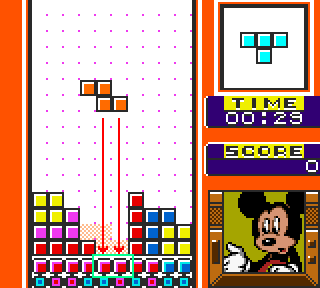
This is the first mode to not be in the console ports of this game, and is also extremely confusing. Listen carefully, because it's extremely difficult to figure this out just by gameplay.
- The very bottom row of your playfield is the sample. If you play on Easy or Normal, these are red and blue. If you play on Hard, these are red, blue, and yellow.
- The row above the sample is your signal.^Roll credits! Your goal is to make your signal match the sample.
Whenever you clear lines, look at only the portions of the piece that got cleared along with the lines you finished by placing said piece. For every column that the piece occupied in the cleared lines, the corresponding signal at the bottom of the screen will switch colour (Red ↔ Blue if in Easy or Normal mode; Red → Blue → Yellow → Red if in Hard Mode). This is illustrated in the diagram, which I highly recommend you look at because I genuinely have no clue how to better put this mechanic in words.
Whenever a part of your signal switches to the correct colour, you get a bonus of one line removed from the bottom of your stack (denoted by the combo counter for some reason). Lines removed in this manner have no effect other than making it easier for you to finish the round.
You win as soon as your signal completely matches the sample. You are then awarded points based on how fast you matched the sample (see table). Unlike the other singleplayer modes, you earn the same amount of points regardless of difficulty.
In Quest mode, winning one round counts as winning the challenge. In singleplayer, winning a round clears your board, sets all your signals to red, and gives you a new sample to match, with no end.
This mode is extremely divorced from Tetris, but is surprisingly fun once you get the hang of it. Good luck explaining it to anyone, though, as it's much easier to play than it is to explain.
Towering Tetris
Another GBC-exclusive mode, and thankfully this one is a lot easier to explain. You begin with a handful of garbage lines on your board -- the top of a tower -- and every time the clock on the right fills up, one line of the tower gets pushed onto the bottom of the board as soon as you place a piece that doesn't clear any lines. If you clear all the garbage lines off the board, the next piece you place will cause the clock to skip to the end and immediately advance the tower one row. At the very bottom of the tower is a keyhole block; you win as soon as you clear it.
In singleplayer mode, the height of the tower depends on the difficulty that you play. Easy towers are 19 rows tall; Normal towers are 25 rows; Hard towers are 43 rows. In Quest mode, towers are 19 rows tall regardless of difficulty. No matter what difficulty you play, the first 7 rows of the tower will initially be on your board.
There is one exclusive mechanic to this mode -- the Shot Block.*This is the name given in the instruction manual. I prefer to call it the Gun Piece,^(patent pending) though.. It is a 1x2 metal block, appears rarely, and whenever it enters play, gravity immediately lowers to the minimum for as long as you have control of the piece. Whenever you rotate the Shot Block, instead of rotating, it shoots one block at your stack in the column that the piece is in. Lines you clear with the shot blocks immediately disappear*These actually count for combo lines, so you can get some stupid high combos with this., but the piece itself disappears as soon as you place it, and it cannot clear lines.
This mode is quite fun, but it takes a while to get through, especially compared to the other modes you'll encounter in Quest Mode. Also be careful to not top yourself quickly out over stupid mistakes (which I've done before!).
Target Tetris
Another GBC exclusive, this is unironically my favourite mode in the whole package. For each stage, you are given a preset field with various target blocks on it, and you are given full view of an entire preset piece sequence. Your only goal is to clear all the target blocks off the field with the provided pieces. The target blocks are either acorns, fire symbols, or lightning symbols, but there is no mechanical difference between them (the change is only visual). In Quest mode, the targets are themed based on whoever offers you the challenge: Chip/Dale have acorns, the fire station has fire symbols, and the power station has lightning symbols. In 1P mode, one of the three types of targets is chosen at random.
To get one thing out of the way, an important mechanic the game never explains in-game: As long as you haven't placed your final piece, you can press Select at any point to retry the stage from the beginning for no penalty. This is especially useful in Quest Mode to avoid having to go through cutscenes multiple times.
Other than that, the only other thing to note is that the stages you play depend on your difficulty There are a total of 135 stages on the cartridge, but each mode only has up to 50 puzzles assigned to it. Easy has you play stages 1 through 50; Normal has stages 51 through 100; and Hard has stages 101 through 135. In 1P mode, you play every stage of the chosen difficulty in order, with the ability to replay already cleared stages with Select + D-Pad. In Quest Mode, you are given one stage out of a pool of 16 from the difficulty group that you must clear. The stage pools are as follows:
| Easy | 9 | 10 | 11 | 14 | 15 | 16 | 17 | 18 | 21 | 22 | 23 | 25 | 27 | 29 | 33 | 36 |
|---|---|---|---|---|---|---|---|---|---|---|---|---|---|---|---|---|
| Normal | 52 | 53 | 54 | 55 | 56 | 57 | 58 | 59 | 60 | 62 | 63 | 64 | 65 | 66 | 67 | 75 |
| Expert | 102 | 103 | 104 | 105 | 106 | 107 | 108 | 110 | 112 | 113 | 116 | 117 | 118 | 119 | 120 | 121 |
A lot of the earlier stages are simple packing puzzles, but the difficulty really ramps up in the Hard puzzles, which involve weird stacking behaviours, spins, red herrings, and then also Stage 120 being a reaction speed test. I could go on about each individual stage, but I feel it would be a lot more fun to try and solve them yourself.
I should warn you, however, to be very careful of Stage 120. You have to do a handful of simple spins with an L piece, which are easy in isolation. However, remember at the beginning when I said the lock delay for each piece is 30 frames total? In order to maneuver the piece to the bottom of the field, you have to take every movement as soon as it is available. If you hesitate even a little, you run out of lock delay extremely quickly, and you don't get to restart the stage since it's your one and only piece. Be very careful with this stage.
Harmony Tetris (2P Only)
Harmony Tetris is exclusive to the 2P link cable mode.*If you want to play this yourself, I have found the best results with BGB. Also make sure to pick two profiles with different names, because the game likes to crash if both players have the same name. Each player has their own seperate board, and lines will only clear as soon as the same line is filled on both boards. If one player fills a line that the other player hasn't, the line will not clear and a corresponding indicator will light up on the other player's field.
At any point, either player can press Select to swap playfields. Each player keeps their active piece (and it is moved back to the top of the board), but their stacks will swap. There is no limit to the amount of times you can do this, and there is no cooldown.
Because of the unusual nature of this mode, the combo mechanics are a lot more lenient. Combo only breaks if both players' last piece placement cleared no lines. That means that if P1 clears a line, P2 clears a line, and P1 puts down a non-clearing piece, the combo is still active. Since swapping playfields brings both pieces back to the top, you can get an infinite combo if you play carefully enough, which is extremely funny.
With that, though, that concludes the singleplayer mode breakdown. However, that is not the crux of this game. I will begin by providing a general overview of the mode; after which, I will go in-depth on all the mechanics. I recommend trying to figure some of them out yourself though -- this mode's quite fun!
Quest Mode
Quest Mode is what Story Mode from the arcade version wishes it was. Instead of playing a handful of CPU battles in a row, you have to run around a decently large overworld, running around to beat people clear special challenges in Tetris in order to collect coins.
Overview
You get to pick one of four playable characters: Mickey Mouse, Minnie Mouse, Donald Duck, or Goofy^Does he have a last name? I'm not caught up with the lore.. You will be playing aganist the three characters you didn't choose, along with Pete, who will also be joining the competition.*If you beat Quest Mode four times, you can choose to play as him as well!
After the intro cutscene, you are immediately thrown into the overworld. You are given a coin case, capable of holding six coins -- along with one of the coins you need, for free! Your goal is to collect the remaining five coins from other participants, buildings, or other events. How exactly you get these coins depends on who or what you play:
- Talking to a rival in the Tetris Coin Rally lets you challenge them for any of the coins they carry. Win, and you get to take one of their coins; lose, and they get to take one of your coins. If an opponent really wants one of your coins, they will chase you around the overworld and lock you into a battle if you can't dodge them.
- Talking to a non-rival NPC lets you challenge them, for a coin they may or may not have. Some of the NPCs have coins, whereas some do not; if they do not, you will be given a hint as to who actually has the coin. If you lose, you gain nothing.
- Talking to a building lets you play the owner's own custom "puzzle" Tetris*As in, either Challenge (Standard with a score/line goal), Towering, Signal, or Target Tetris. Magical and Updown Tetris are for fighting other characters.. If you lose, you get to try again; if you win, you get their coin!
- Talking to other objects (lampposts, mailboxes, telephones, and manholes) give you hints about the game. Some of the hints even tell you where other coins are, who has what coins, or maybe some other useful info!
You can press the A button to "knock" on things; you can knock on characters or objects to interact with them. The first person (or CPU) to get all six of their necessary coins and return to the Rally Station in the bottom-left corner of the map is the winner!
Coins
The goal in this mode is to collect six numbered coins. The coins are numbered 1 through 18, but each coin is not equally likely to be given to a specific building or character! The coins are grouped into three categories, which I refer to as the "player", "group", and "building" categories respectively:
- Coins 1 through 6 are randomly given to Mickey, Minnie, Donald, Goofy, Pete, and Daisy Duck. As a consequence, you will start with one of these coins.
- Coins 7, 8, 9, and 10 are randomly given to the following groups, with exactly one character in each group getting a coin:
- Either Clarabelle Cow or Horace Horsecollar.
- Either Wolf or Weasel.
- Either Chip or Dale.
- Either Huey, Dewey, or Louie.
- Coins 11 through 18 are randomly given to the power station, the fire station, the school, the bank, the post office, Tetris Square*Sometimes referred to in-game as "the park"., the trolley bus, and one random manhole*One of the hints that can be offered will tell you which manhole it is..
When you are given your case of coins, you are given 6 slots, one of which is already filled, each containing a specific numbered coin you must obtain. While the coins in each category are random, the slots are guaranteed to contain:
- The coin you start with.
- Two other coins from the "player" category.
- One coin from the "group" category.
- Two coins from the "building" category.
At any point, you can knock on the rally station (bottom-left corner of the map) to see all the coins that each competitor has, along with their current ranking. After a period of time in the overworld has elapsed, a buzzer sounds and a cutcene plays that shows the current rankings, along with how many coins each competitor has, but not which coins they are specifically. Note that if you knock on the rally station as soon as the game begins, you can find the exact locations of coins 1-6. (Remember that Daisy Duck is given whichever coin was not given to any of the five competitors.)
Hints
Knocking on a lamppost, mailbox (except the one in front of the post office), or phone (except the ones at the school and fire station) will offer you a hint for the game. Hints can include (TODO: Get the exact wording on those examples):
- Flavour text (e.g. "The number you have dialed is no longer in service.", "Hi [CHARACTER]! How are you today?")
- General Tetris advice (e.g. "Magical Tetris Tip: Line up the pieces so that two vertical lines are left open.")
- Quest Mode advice (e.g. "If you lose a coin, go back to where you found it and challenge them again.")
- The locations of specific coins (e.g. "Word is... someone dropped coin #X into a manhole somewhere.", "Just between you and me, I heard that either Wolf or Weasel has coin #X.", "Word is... there's a coin in the manhole near [LOCATION].")
- One of the three parts for the Hidden Island's game of Signal Tetris (see below).
Free Coin
The very bottom-right corner of the map is home to Hidden Island. The lone hut on the island offers a special game of Signal Tetris -- instead of the sample being given to you when the game starts, you must first find the three parts of the sample*The three hints are the left 3, middle 4, and right 3 samples. as hints offered by lampposts, mailboxes, and phones. Only once you have found all three hints may you play the hut's Signal Tetris, and winning it gives you the Free Coin, which is a wildcard coin and can act as any number*As soon as you get your 5th coin, it will occupy the spot of the 6th. If you have fewer than 5 coins, it will be set aside until you get your 5th..
Challenges
Each competitor, NPC, and building offers a different Tetris challenge that is available if you knock on them. If you knock on a competitor, you will be given the chance to battle them for one of their coins (which they may or may not tell you the numbers of).
- If you win a battle against a competitor, you get to take one of their coins. If you lose, they will steal one of your coins. If you have no coins on you, you cannot play any of the other competitors. You must get a coin from an NPC or building first.
- If you win against an NPC, you will get their coin if they have one, and gain nothing if they don't. If you lose, nothing happens.
- If you win against a building's challenge, you win its coin. If you lose, nothing happens and you can try again.
Some competitors will chase after you if you have a coin they want, along with Wolf and Weasel, who will almost always chase you. If they catch you, you will be forced to battle them for the same stakes (losing against Wolf or Weasel still has no effect). If you manage to knock on a character chasing you before they catch you, you can choose whether or not to challenge them. Otherwise, you are locked into the battle.
If you win a coin that you don't need, you will still steal the coin (if you got it from a competitor), but it will be thrown away and you can't use it for anything.
Each challenge is always the same depending on who or what offers it:
- Mickey, Donald, and Pete offer Magical Tetris.
- Minnie, Goofy, and Daisy Duck offer Updown Tetris.
- Wolf and Weasel both offer Towering Tetris.
- Chip and Dale both offer Target Tetris.
- Horace and Clarabelle offer Challenge Tetris. (7/8/16 lines in 2/1/1 minute)
- Huey, Dewey, and Louie all offer Signal Tetris.
- Tetris Square offers Challenge Tetris. (200/1200/15000 points in 2/1/1 minute)
- The trolley bus offers Signal Tetris, with the sample guaranteed to be entirely blue.
- The post office offers Towering Tetris.
- The fire station offers Target Tetris.
- The power station offers Target Tetris.
- The bank offers Signal Tetris.
- The school offers Challenge Tetris. (150/1000/12000 points and 5/6/12 lines in 2/1/1 minute)
- The manhole coin is given to you for free with no strings attached.